
A2LA Accredited Exposure Sciences Laboratory
Particle Size Distribution Testing & Exposure Science Consultation
RHP Risk Management’s (RHP) Exposure Sciences Laboratory (ESL) delivers testing and exposure science services that help organizations make confident decisions about occupational and environmental health risks. Our laboratory provides scientifically defensible data to support compliance, product stewardship, legal matters, and risk management.
Talk with Our Laboratory Team →
ISO 13320:2020 Laser Diffraction
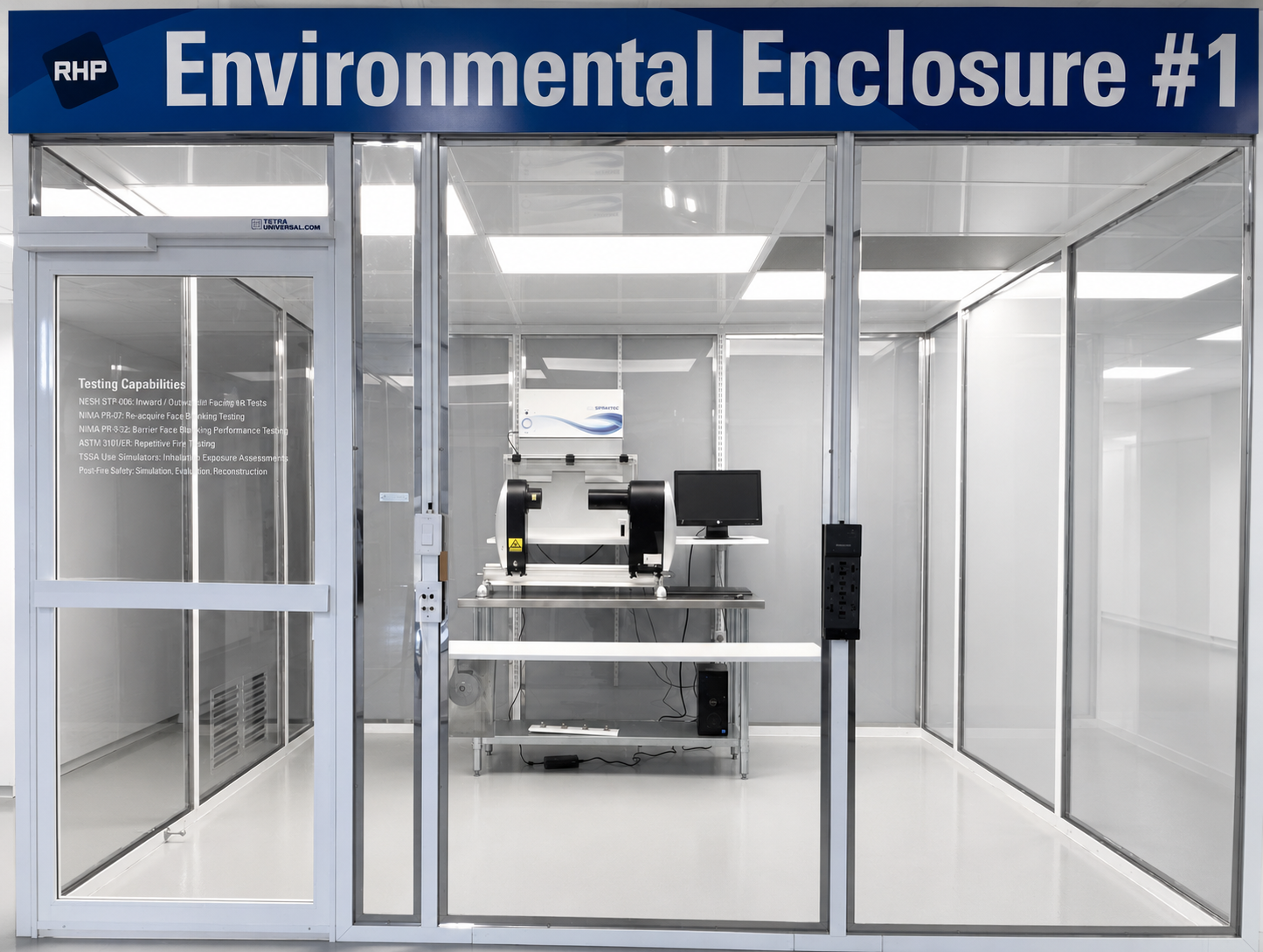
RHP’s ESL performs ISO 13320:2020 laser diffraction analysis using a Malvern Spraytec™ 2000 equipped with a 300 mm lens. The system measures particle and droplet size distributions from approximately 0.1 to 900 µm and can characterize both continuous and rapid spray events.
A2LA Accreditation
A2LA Accreditation provides confidence that analyzed results are generated by qualified personnel using controlled methods, calibrated and verified equipment, data-integrity practices, and a robust laboratory quality system.
Expert Interpretation
RHP’s Human Health Risk Sciences team provides additional support to help turn reliable, defensible laboratory data into actionable, decision-ready insight for product development, exposure science, product stewardship, regulatory strategy, and risk management.
Industries including consumer and personal care product companies use particle and droplet size distribution (PSD) testing to support product development, quality assurance, performance validation, and regulatory submissions. Results can support compliance with industry-specific standards and guidance, including ISO 13320:2020 for laser diffraction particle size analysis, and FDA, European Union Cosmetics Regulations, and associated Scientific Committee on Consumer Safety (SCCS) guidance.
An A2LA accreditation confirms that a laboratory operates with demonstrated technical competence, validated methodologies, and a robust quality management system. RHP’s accredited laboratory services are evaluated against rigorous international standards, including ISO/IEC 17025, giving clients confidence that results are reliable, consistent, and recognized by regulators and stakeholders.
Our accredited capabilities support organizations that need scientifically sound data to evaluate exposure risks, validate assumptions, and make informed risk management decisions.
PSD Data That Answers More Than “What Is the Average Size?”
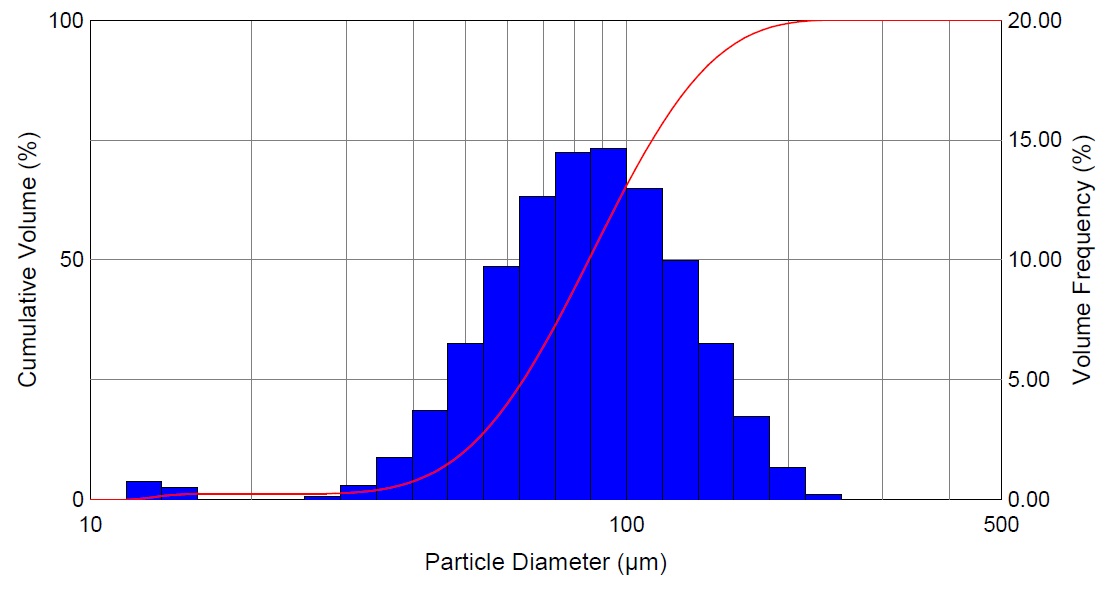
Sprays contain a range of droplet or particle sizes, not a single uniform size, and that distribution can change during use. Formulation, device and nozzle design, pressure, spray distance and angle, and environmental conditions can all affect how a product atomizes and behaves.
Particle size distribution (PSD) testing characterizes this full range of droplets or particles. Using laser diffraction, the Malvern Spraytec™ measures how a spray scatters light and converts that information into a volume-based size distribution in real time. This makes it well suited for both continuous sprays and rapid, short-duration events.
RHP Risk Management’s Exposure Sciences Laboratory uses the Malvern Spraytec™ 2000 to evaluate aerosols, pump sprays, and other atomized products across pharmaceutical, medical-device, cosmetic, consumer-product, agricultural, coatings, automotive, aerospace, and industrial-safety applications. The resulting data can help clients optimize formulations and nozzle performance, compare product designs, and understand spray characteristics that influence coverage, deposition, drift, product performance, and airborne behavior.
Particle and droplet size data can also help identify the portion of a spray that may remain airborne and be available for inhalation, an important input to potential human exposure and health-risk evaluations. Combined with product-use information, formulation details, and RHP’s exposure science and toxicology expertise, these data can support product stewardship, safety assessments, regulatory submissions, responses to evolving expectations from agencies such as FDA, EPA, OSHA, EU, and state regulatory authorities, and decisions about whether further testing, reformulation, controls, labeling, or other risk-management measures may be appropriate.
RHP Can Design PSD Studies to Evaluate Questions Such As:
- How consistent is a spray from one actuation, product, batch, or device to another?
- Does a formulation or viscosity modification shift the droplet-size distribution?
- How do nozzle type, distance, or angle affect atomization?
- What portion of the measured spray falls below a selected size threshold?
- Does particle size change during the beginning, stable phase, or tail-off of an actuation?
- Which product or operating condition best meets a performance or exposure-science objective?
RHP’s ESL can support single-product characterization, formulation comparisons, device or nozzle comparisons, distance and angle studies, product-life or dose-progression studies, and controlled simulations of realistic product use. Any custom study design is established before testing, so empirical data addresses the client’s actual scientific, product-development, exposure, or risk-management decision.
Whether evaluating formulation changes, nozzle performance, droplet consistency, product coverage, drift potential, or airborne particle generation, our laboratory provides accurate, defensible data to support product development, regulatory submissions, manufacturing optimization, and product stewardship. Beyond laboratory testing, RHP’s multidisciplinary team of Certified Industrial Hygienists, toxicologists, exposure scientists, and risk assessment professionals can interpret PSD results within the context of occupational, consumer, and environmental exposure scenarios to help clients make informed scientific, regulatory, and business decisions. This combination of accredited laboratory testing and Human Health Risk Sciences expertise is what distinguishes RHP from traditional analytical laboratories.
A2LA Accreditation, Quality, and Transparency
RHP Risk Management Inc.’s Exposure Sciences Laboratory, located at 670 Oakton Street in Elk Grove Village, Illinois, is A2LA accredited in accordance with ISO/IEC 17025:2017 for the activities listed on Certificate 7743.01, valid through March 31, 2028.
A2LA accreditation is based on third-party evaluation of a laboratory’s technical competence and quality management system. For clients, RHP’s accredited status provides added confidence that covered results are generated using qualified personnel, controlled procedures, calibrated and verified equipment, documented data-integrity practices, and ongoing quality control or quality assurance oversight.
Where laboratory data can affect health decisions, liability, product development, or business outcomes, this framework helps reduce uncertainty and supports more informed decision-making. Accredited results can also provide added credibility with regulators and other stakeholders.

Available Downloads / Documentation
Verify RHP’s accreditation and prepare samples for laboratory analysis.
A2LA Certificate and Scope of Accreditation
View our current certificate and the specific tests and services included under RHP’s A2LA accreditation (Certificate 7743.01).
Download Certificate & Scope (PDF)Chain of Custody Form
Download and complete our Chain of Custody form when submitting samples for laboratory analysis.
Download Chain of Custody Form (PDF)Already a client? Share feedback on our laboratory services
Questions? Call (866) 481-8188
Contact RHP or call (866) 481-8188 to discuss how our accredited laboratory services can support your organization.
Please Note: Accreditation applies only to the activities, methods, and location listed on RHP’s current A2LA Scope of Accreditation. A2LA accreditation does not constitute endorsement of RHP personnel, products, services, opinions, interpretations, or client products. Not all RHP services described on this page are within the accredited scope.