
Defensible Science for Chemical Exposure, Health & Regulatory Decisions
RHP integrates exposure science, toxicology, and epidemiology to evaluate potential human health risks, delivering objective, scientifically rigorous insights that withstand regulatory and legal scrutiny.
Request a Consultation
Health-Based Emissions Limits: Integrating Evidence for Threshold vs. Non-Threshold Health Effects Using HCl as an Example
RHP scientists evaluated 34 epidemiology, animal and genotoxicity studies to determine when the evidence supports a threshold-based approach to cancer risk assessment, using hydrochloric acid (HCl) as a case study. The analysis informs health-based emissions limits under Clean Air Act Section 112(d)(4) and shows why exposure context matters when interpreting hazard data.
Key Takeaways: RHP’s Human Health Risk Sciences Services
See How RHP Supports Human Health Risk Sciences
Explore Our Human Health Risk Sciences Practice
Select an area below to jump directly to that discipline.
How RHP’s Human Health Risk Sciences Supports Clients
- Integrated evaluations of potential human health risks across exposure science, toxicology, and epidemiology.
- Assessment of chemical hazards and exposure pathways across occupational, environmental, and consumer settings.
- Development of defensible exposure and risk data to support regulatory decisions and product stewardship.
- Scientific analyses and expert support for regulatory, litigation, and public health decisions.
Integrated Science to Evaluate Chemical Risks and Support Regulatory, Legal, and Corporate Decision-Making
RHP supports clients across industry, government, and legal sectors by translating complex scientific evidence into clear insights that withstand scrutiny from regulators, courts, and scientific peers.
Organizations evaluate potential human health risks from chemical exposures across manufacturing, consumer product use, and environmental pathways. Addressing these challenges requires defensible science that integrates exposure data, toxicological evidence, and epidemiologic research.
RHP’s Human Health Risk Sciences (HHRS) practice combines expertise in exposure science, toxicology, epidemiology, and risk assessment to evaluate hazards, quantify exposures, and characterize potential human health risk.
Our multidisciplinary teams apply scientifically accepted methods to develop reliable data and evidence-based conclusions, including:
- Exposure modeling
- Environmental sampling
- Laboratory testing
- Dose-response analysis
- Systematic review & hazard characterization
- Benchmark dose modeling
- PBPK modeling
- Risk characterization & communication
Meet Our Experts


Our Related Services
Integrated Human Health Risk Science
Understanding potential human health risks requires evaluating multiple lines of scientific evidence. RHP integrates three core disciplines to provide comprehensive assessments of potential human health risks.
Case Studies
Conventional vs. New Technologies for Evaluating Engineering Controls Through the SARS-CoV-2 Pandemic and Beyond
RHP conducted an internal research study investigating and replicating installation and performance of needlepoint bi-polar ionization (NPBI) air purification technology in real-world, as-installed environments.
Read the case study →Cleaning and Disinfecting Efficiency Study
Using ATP bioluminescence and RT-qPCR methods, RHP evaluated cleaning procedure effectiveness across simulated exposure scenarios to assess hygiene intervention performance in the workplace.
Read the case study →Respirator Fit Capability for Negative-Pressure Half-Facepiece Particulate Respirators (ASTM F3407-21)
RHP examines the ASTM F3407-20/21 Standard Test Method, which provides increased assurance that respirators can effectively fit a range of face shapes and sizes when fit tested per 29 CFR 1910.134.
Read the case study →Frequently Asked Questions
Learn more about human health risk assessment and how RHP’s integrated approach can support your organization.
What is a human health risk assessment?
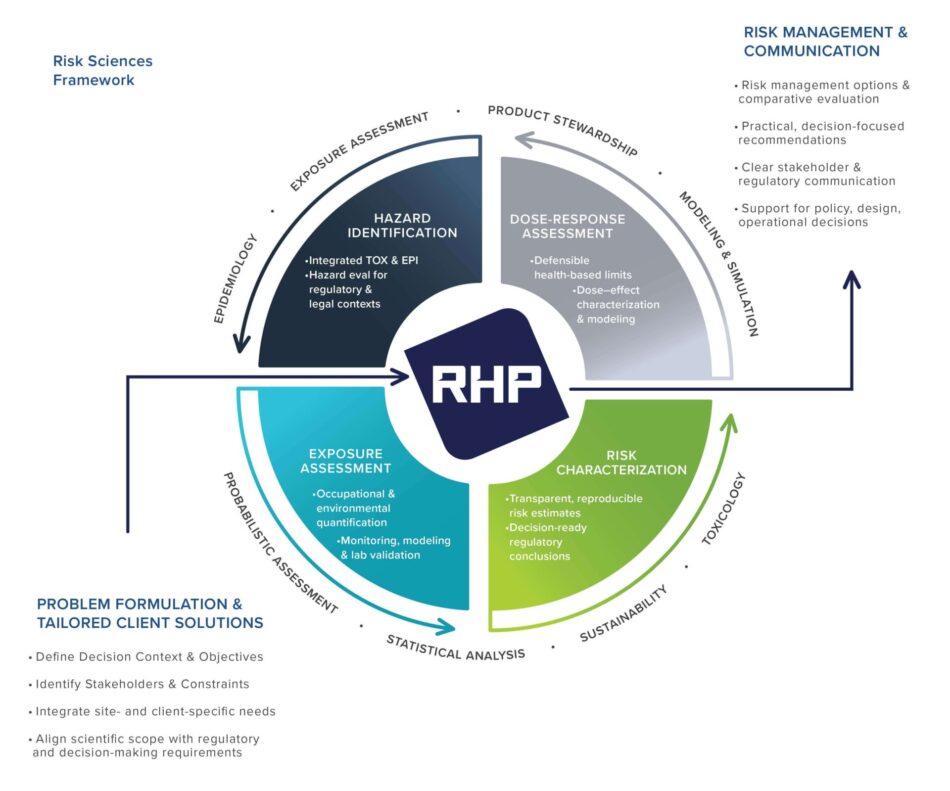
A human health risk assessment is a systematic evaluation of how a chemical or other hazard may affect people under specific exposure conditions. It combines hazard identification, exposure assessment, dose-response analysis, and risk characterization to estimate potential health risks and support regulatory, product, public health, or legal decisions.
What Are the Steps in a Human Health Risk Assessment?
A human health risk assessment typically follows four steps:
- Hazard identification: determine whether an agent can cause an adverse health effect.
- Dose-response assessment: evaluate how the likelihood or severity of an effect changes with dose.
- Exposure assessment: estimate who may be exposed, by which route, and at what level.
- Risk characterization: combine the evidence to describe potential risk and uncertainty.
What Is the Difference Between Hazard and Risk?
A hazard is the inherent ability of an agent to cause harm. Risk is the likelihood and potential magnitude of harm under particular exposure conditions. A sound human health risk assessment considers both: it evaluates what an agent can do, then examines who may encounter it, at what dose, for how long, and through which route.
What Types of Exposure Are Evaluated?
Human health risk assessments may evaluate exposure in several settings:
- Occupational exposure during manufacturing, handling, or maintenance
- Environmental exposure through air, water, soil, or consumer pathways
- Consumer exposure during normal or foreseeable product use
- Historical exposure reconstructed from records, models, and scientific evidence
Recent News & Insights
Loading recent HHRS news…
Which HHRS Service Fits Your Need?
Select what applies to your situation and we’ll point you to the right RHP discipline.
Get In Touch
Contact RHP experts to reduce uncertainty and enable confidence in decision-making by delivering reliable, reproducible, and relevant data. Through early and active stakeholder engagement, we provide customized solutions that support clients with their specific goals.