
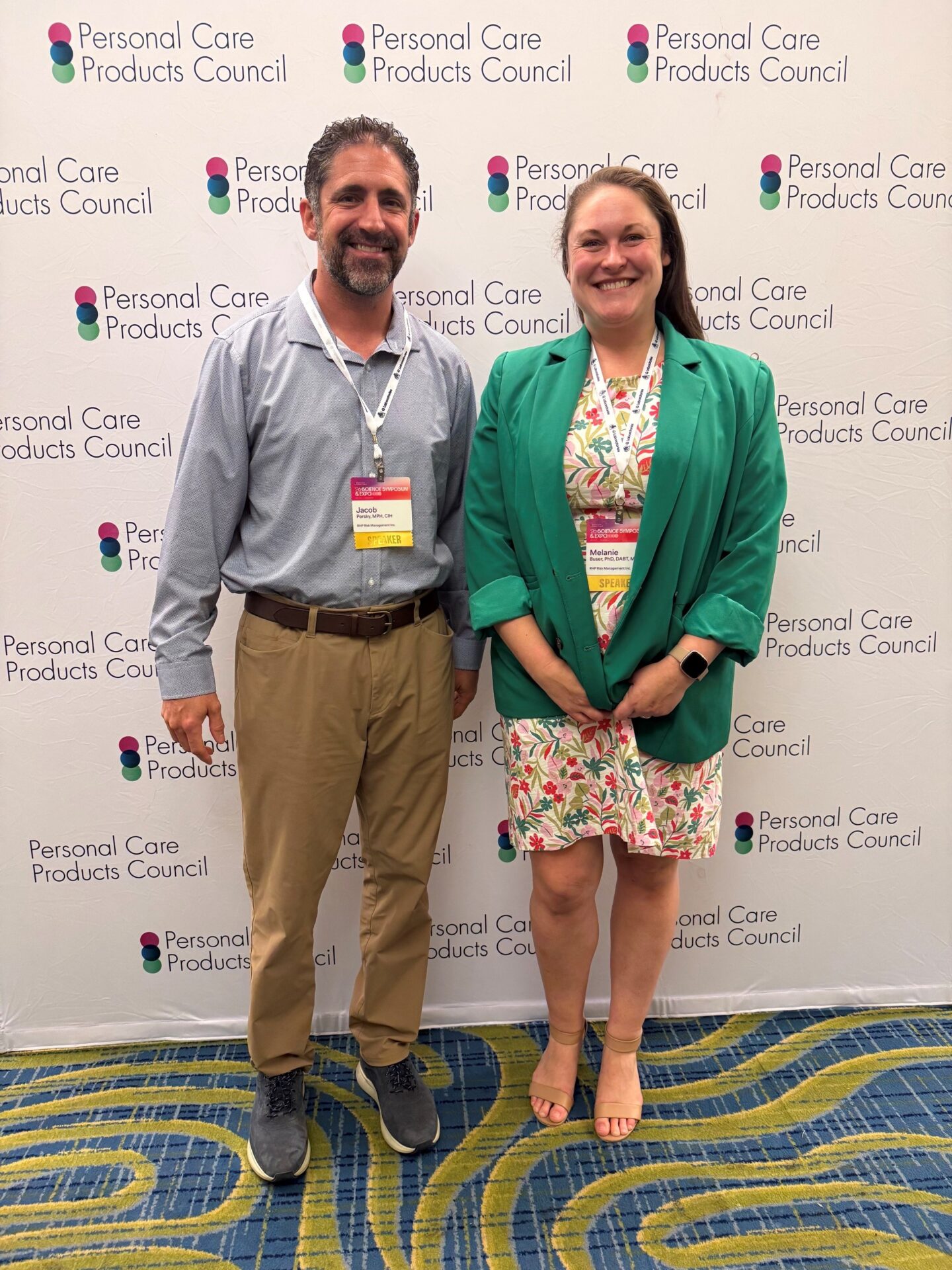
RHP Risk Management’s Melanie C. Buser, PhD, DABT, MPH, and Jacob Persky, MPH, CIH, recently presented at the Personal Care Products Council’s 2026 Science Symposium & Expo in Arlington, Virginia, joining scientists, regulators, and personal care industry professionals for two days of discussion focused on product safety, regulatory science, quality, microbiology, and environmental risk.
Their session, “Mineral Active Ingredients in Personal Care: Reconciling Exposure, Hazard, and Regulatory Approaches Across Jurisdictions,” examined how scientific evidence, real-world exposure, and regulatory frameworks can lead to different conclusions when evaluating mineral active ingredients such as titanium dioxide.
The presentation emphasized the importance of considering not hazard identification alone, but as one component of a robust product level risk assessment. Product safety evaluations also need to account for how an ingredient is formulated, how consumers may be exposed, the magnitude and duration of that exposure, and whether the available toxicological and epidemiological evidence is relevant to realistic use conditions.
Using loose powders, mineral sunscreens, and aerosol products as examples, RHP traced the pathway from an ingredient’s presence in a formulation to its release during use, airborne particle characteristics, pulmonary deposition, and biologically relevant dose associated with adverse effects. The session also compared U.S. and European regulatory frameworks and highlighted an important practical distinction: ingredient presence or hazard classification alone does not establish product-level risk. Product-specific exposure evidence and a transparent margin-of-safety analysis can inform the risk characterization.
Broader Themes from the 2026 PCPC Symposium
Modernization of safety assessment
Speakers consistently framed New Approach Methodologies, or NAMs, as components of an integrated evidence strategy rather than one-for-one replacements for individual animal studies. Discussions emphasized fit-for-purpose test batteries, context of use, validation against existing evidence, transparent documentation, and early engagement with regulators. The recurring message was that regulatory confidence depends not only on scientific innovation, but also on standardized methods and clear decision criteria.
Regulatory change and evolving oversight
Regulatory change was another major focus. Sessions addressed implementation of the Modernization of Cosmetics Regulation Act, FDA inspection and import oversight, contamination and reporting, and the anticipated development of mandatory cosmetic good manufacturing practice requirements. The discussions reinforced the need to build scientific documentation and product stewardship into the full product lifecycle rather than treating them solely as responses to an inspection or incident.
Sunscreen science and regulation
Sunscreen science and regulation were also prominent throughout the meeting. Sessions addressed changes in U.S. sunscreen formulations, mineral and organic UV filters, preservation challenges, future regulatory pathways, and the use of real-world evidence in evaluating sunscreen ingredients.
FDA’s 2026 addition of bemotrizinol at concentrations up to 6 percent to the OTC sunscreen monograph provided a timely example of how NAMs, human exposure information and extensive real-world experience can contribute to a regulatory evidence package. Symposium speakers discussed the decision as an important development for both sunscreen innovation and the use of integrated evidence in ingredient evaluation.
Environmental risk assessment
Environmental risk assessment is also moving toward tiered, exposure-led, and hypothesis-driven approaches. Presentations examined how use and release information, environmental fate, effects data, and non-animal ecotoxicity methods can be integrated into next-generation environmental risk assessments, Speakers also highlighted probabilistic modeling and transparent documentation of uncertainty as tools for refining conservative assumptions while maintaining protective decisions.
Practical compliance and product stewardship
The conference also placed a strong emphasis on practical compliance and product stewardship. Topics ranged from FDA inspections and cosmetic recalls to current good manufacturing practices, supply-chain accountability, and microbial safety. Sessions also raised an unresolved practical question: how AI applications used within quality systems should be trained, validated, documented, and maintained under meaningful human oversight.
For more information on the 2026 symposium program, visit the PCPC Science Symposium & Expo agenda.
Applying Exposure and Risk Science to Product Safety
The themes discussed at PCPC closely align with RHP Risk Management’s approach to product safety and Human Health Risk Sciences.
RHP’s multidisciplinary teams integrate exposure science, toxicology, epidemiology, risk assessment, and laboratory testing to help clients evaluate ingredients and finished products under realistic conditions of use. This can include exposure modeling, product-specific testing, hazard characterization, dose-response analysis, weight-of-evidence evaluations, and support for product stewardship and regulatory decision-making.
For companies navigating evolving ingredient requirements, changing regulatory expectations, or questions regarding consumer exposure, the ability to connect hazard information with realistic exposure data can be critical to developing scientifically defensible conclusions.
Contact RHP Risk Management at (866) 481-8188 to set up an initial consultation and learn more about our Human Health Risk Sciences services, product stewardship, and exposure science capabilities.