
Key Takeaways:
- Our toxicology services combine expertise in exposure modeling, quantification, toxicology, and epidemiology to assess potential risks to human health and the environment, informing strategies for compliance with OSHA’s Hazard Communication Standard (29 CFR 1910.1200) and other relevant regulations.
- We collaborate with various entities to enhance understanding of chemical risk profiles, identify safer alternatives, and implement effective risk management measures, helping businesses determine appropriate controls to meet OSHA’s Permissible Exposure Limits (PELs) and requirements for personal protective equipment (PPE) (29 CFR 1910 Subpart Z and 29 CFR 1910.132).
- RHP’s state-of-the-art A2LA Accredited Exposure Sciences Laboratory (ESL) offers clients exclusive opportunities to develop scientifically accepted approaches in exposure sciences and toxicology, providing data to support informed decisions about workplace safety and compliance with OSHA regulations.
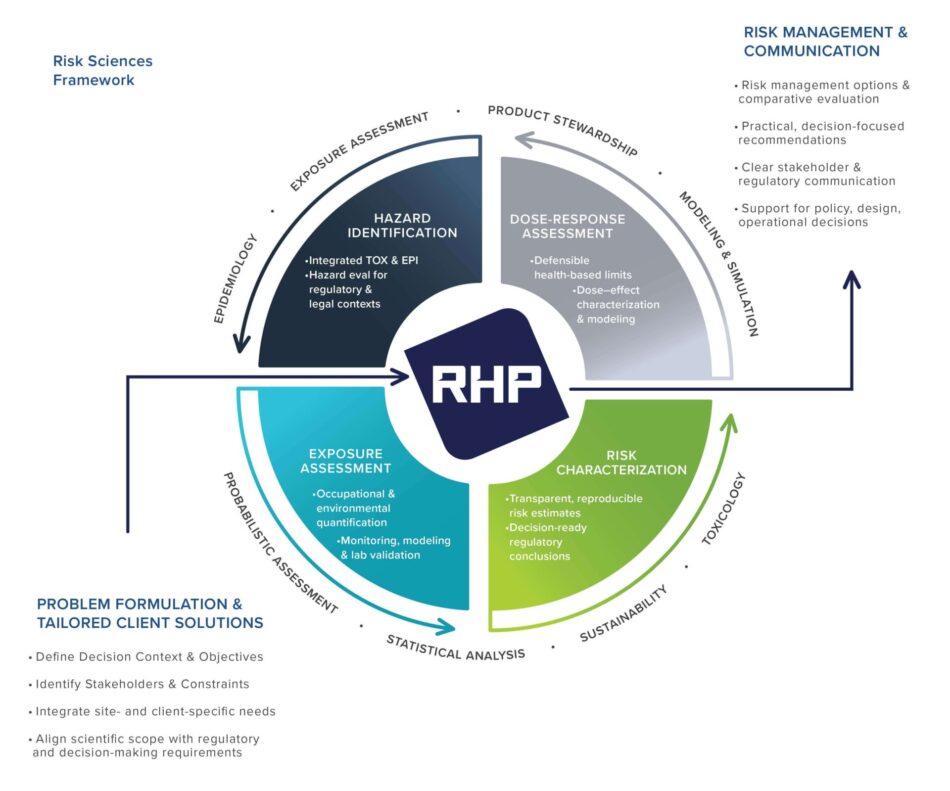
RHP scientists are well versed in exposure modeling, laboratory and field-based quantification of exposures, toxicology, and epidemiology and use a combination of these expertise to assess potential risks to human health and the environment. RHP collaborates with chemical manufacturers, product manufacturers, consumer good, pharmaceutical, and legal entities to help gain a better understanding of risk profiles of chemicals, identify safer and more sustainable alternatives, bolster decision making via use of robust scientific methods, and formulate economically and technically feasible risk management measures. RHP scientists rely on scientifically accepted and recognized approaches in toxicology, epidemiology, exposure modeling and quantification, dose response, benchmark dose modeling, and physiologically based pharmacokinetic modeling to address questions regarding risk profiles of chemicals, identifying safer & sustainable alternatives, enhancing the understanding of risk that leads to better decision making, and implementing risk management measures to effectively and efficiently reduce exposures for workers and consumers.
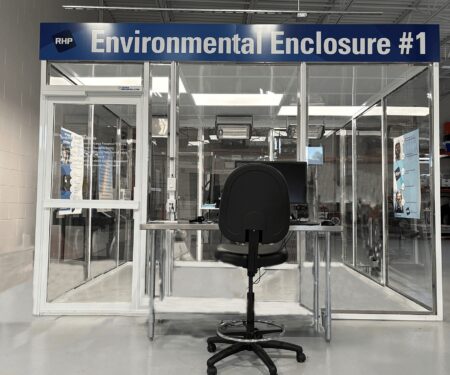
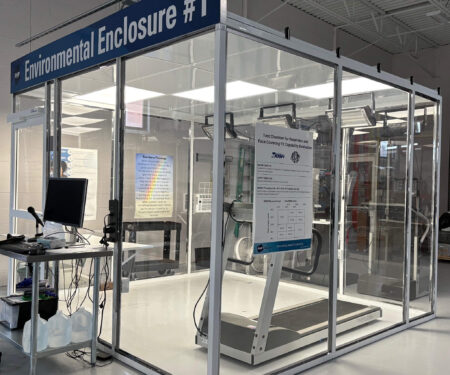
RHP’s state-of-the-art A2LA Accredited Exposure Sciences Laboratory (ESL) provides clients with a better understanding of potential exposures and risks to human health and the environment by utilizing industry standard and regulatory accepted methods. ESL offers clients exclusive opportunities to develop scientifically accepted and recognized approaches in exposure sciences and toxicology that will provide them with an understanding of exposure and risk based on sound, defensible, science. RHP professionals have extensive experience in resolving uncertainty and improving decision-making through development of experimentally derived data, which is relevant, reliable, and reproducible. By engaging stakeholders during the problem formulation stage, RHP ensures that assessments are tailored to meet the intended purpose.
Toxicology services combine expertise in exposure modeling, quantification, toxicology, and epidemiology to assess potential risks to human health and the environment. RHP scientists use scientifically accepted and recognized approaches in toxicology, epidemiology, exposure modeling and quantification, dose response, benchmark dose modeling, and physiologically based pharmacokinetic modeling to address questions regarding chemical risk profiles.
Toxicology services are beneficial for chemical manufacturers, product manufacturers, consumer goods companies, pharmaceutical companies, and legal entities. These organizations collaborate with toxicology experts to understand risk profiles of chemicals, identify safer alternatives, and implement effective risk management measures.
RHP scientists use expertise in toxicology, exposure modeling, and risk assessment to gain a better understanding of chemical risk profiles and identify safer and more sustainable alternatives. By utilizing robust scientific methods and collaborating with clients, toxicology services help formulate economically and technically feasible alternatives to reduce exposure risks.
Risk assessment in toxicology services is designed to assess potential risks to human health and the environment. By combining expertise in exposure modeling, quantification, toxicology, and epidemiology, these services provide data-driven insights to support informed decisions about workplace safety, product development, and regulatory compliance.