
Key Takeaways:
- RHP delivers end-to-end microplastics support from occurrence testing and exposure assessment to deposition modeling, chemical leaching evaluation, and human health risk characterization.
- Our integrated exposure science approach combines laboratory methods, microscopy-based particle characterization, and mathematical modeling to generate scientifically defensible, decision-ready results.
- We translate complex microplastics exposure data into practical strategies for risk assessment, product safety and stewardship, regulatory support, and scientific advocacy.
- Clients rely on RHP for rigorous, objective analyses that address both particle-based and chemical-component exposure questions.
Microplastics: Exposure, Risk, and Defensible Scientific Evaluation
Microplastics have emerged as an important environmental and public health topic because they are not detected in air, water, and consumer-related environments, creating potential inhalation and ingestion exposure pathways. RHP Risk Management helps clients evaluate microplastics using a science-based framework that integrates occurrence testing, particle characterization, chemical analysis, exposure reconstruction, deposition modeling, and human health risk assessment. This work spans multiple questions of concern, including microplastics in drinking water, inhalation of airborne fibrous particles, particle size- and shape-dependent deposition, and the potential for chemical additive leaching from polymers such as polyvinyl chloride (PVC) and polyethylene (PE).
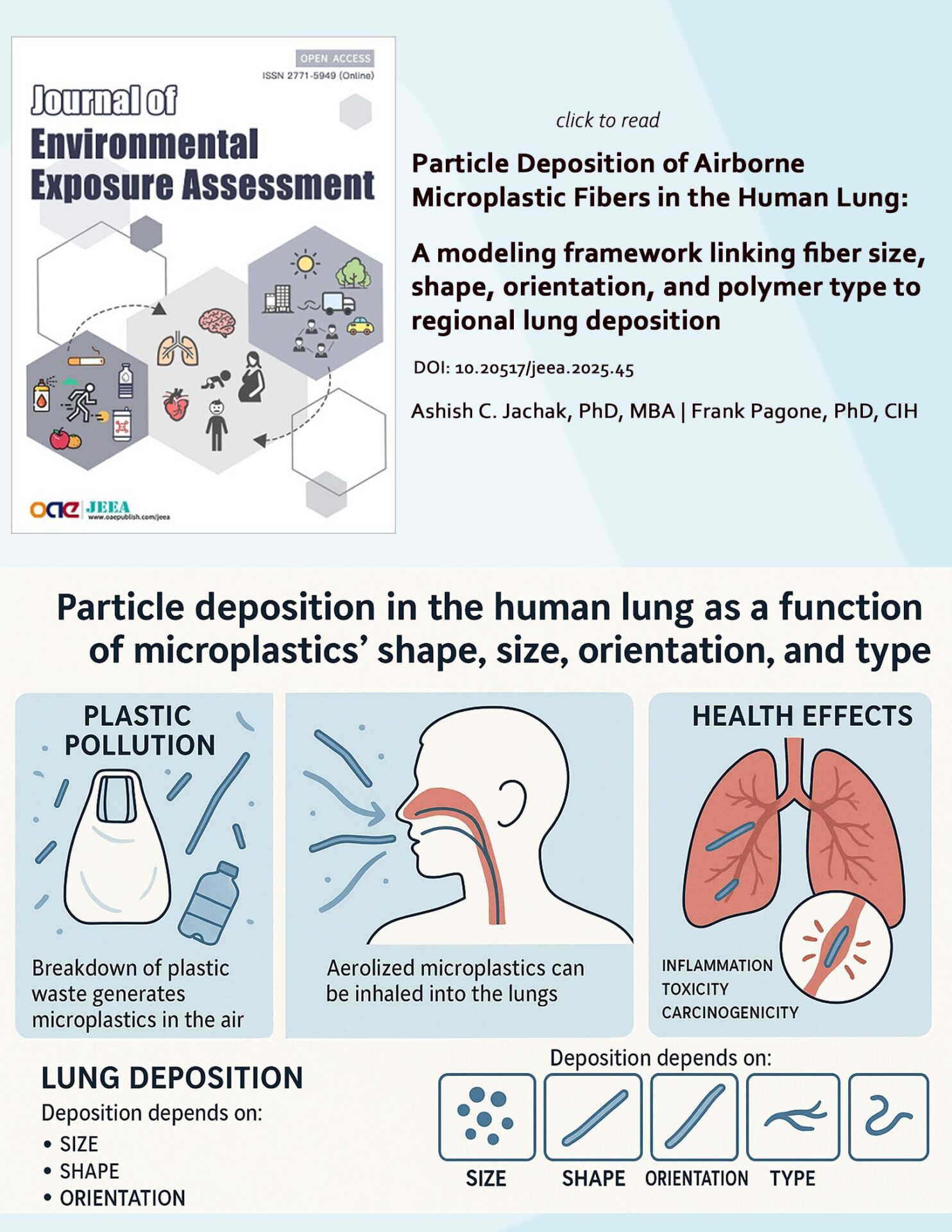
Our approach is grounded in exposure science, focusing on understanding how microplastics behave across environmental and human exposure pathways. In drinking water contexts, RHP evaluates microplastic occurrence, composition, and size characteristics in the context of potential human exposure, including the role of polymer-associated additives and their potential contribution to overall chemical intake. For inhalation, RHP assesses how particle size, shape, density, and aerodynamic behavior influence transport and deposition within the respiratory tract. These evaluations consider region-specific deposition, including the nasopharyngeal, tracheobronchial, and alveolar regions, and the implications for particle retention and biological interaction. Together, these integrated analyses provide scientifically robust and defensible framework for understanding microplastic exposure and its potential health relevance. This enables clients to interpret complex data, prioritize key uncertainties, and make informed decisions related to research, stewardship, risk communication, and regulatory strategy.
How RHP Supports Microplastics
Occurrence Testing and Particle Characterization
RHP designs and interprets microplastics studies to characterize particle occurrence, polymer composition, and size distributions in relevant media. In drinking water, this includes sampling design, contamination control, and microscopy-based particle identification consistent with recognized procedures. Inhalation-focused work can incorporate literature-based particle characterization and scenario development for airborne microplastics, particularly fibrous particles that are most relevant to respiratory exposure.
RHP quantifies potential human exposure to microplastics under realistic or health-protective scenarios. For drinking water, we evaluate ingestion exposure using assumptions about water consumption, particle occurrence, polymer-specific composition, and conservative intake scenarios. For air and occupational or consumer settings, we assess how airborne microplastics may be inhaled based on particle size, morphology, and environmental conditions. This work builds on RHP’s broader exposure science capabilities in laboratory testing, exposure monitoring, and reconstruction.
Deposition Modeling and Respiratory Tract Analysis
RHP applies mathematical deposition models to evaluate where inhaled microplastics are likely to deposit in the respiratory tract. Our work has shown that deposition is strongly influenced by fiber diameter, length, density, and orientation, with the highest modeled deposition for fibrous microplastics occurring in the nasopharyngeal region and notable deposition also possible in the alveolar region. These analyses help clients understand how particle properties affect inhalability, persistence, clearance potential, and toxicological relevance.
Chemical Leaching and Additive Migration Assessment
RHP evaluates the potential for chemicals associated with microplastics to migrate into surrounding media. In drinking water studies, this includes diffusion-based modeling of additive leaching from polymers such as PVC and PE under conservative sink conditions. Additives such as phthalates and phenolic antioxidants can be assessed using polymer-specific diffusion coefficients, contact-time assumptions, and exposure calculations that support screening-level risk characterization.
Human Health Risk Characterization
RHP integrates exposure estimates with toxicological benchmarks to characterize potential human health risks from microplastics and microplastic-associated chemicals. For ingestion scenarios, this includes converting modeled concentrations into absorbed dose estimates and comparing them against health-based benchmarks using screening-level risk metrics. For inhalation scenarios, deposition outputs provide the basis for evaluating site-specific lung burdens, clearance considerations, and the potential relevance of mechanisms such as frustrated phagocytosis for long, thin fibers.
Scientific Strategy, Stewardship, and Regulatory Support
Microplastics questions often sit at the intersection of emerging science, public concern, and evolving regulatory expectations. RHP helps clients interpret screening-level results, identify key uncertainties, prioritize additional data collection, and frame findings for internal decision-making, stewardship planning, scientific advocacy, and external communications. Our integrated approach is designed to turn complex technical questions into actionable, defensible outcomes.
What RHP Delivers
- Microplastics occurrence testing and interpretation for water, air, and other relevant media.
- Particle characterization focused on polymer type, particle size, morphology, and exposure relevance.
- Exposure assessments for ingestion and inhalation scenarios grounded in realistic and conservative assumptions.
- Deposition modeling for airborne fibrous microplastics across regions of the respiratory tract.
- Diffusion-based leaching evaluations for microplastic-associated additives such as phthalates and antioxidants.
- Screening-level human health risk characterizations that integrate exposure science and toxicology.
- Defensible scientific analyses that support stewardship, regulatory strategy, litigation readiness, and risk communication.
Contact RHP experts to reduce uncertainty and enable confidence in decision-making by delivering reliable, reproducible, and relevant data. Through early and active stakeholder engagement, we provide customized solutions that support clients with their specific goals.