
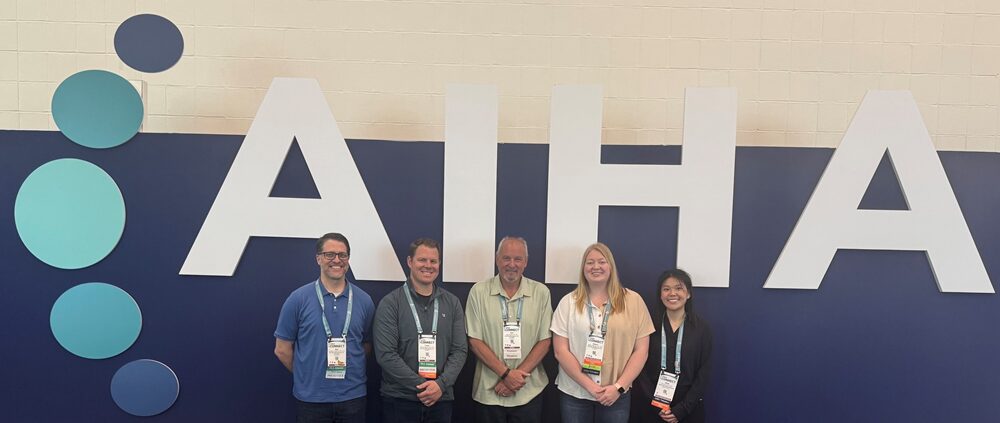
RHP Risk Management professionals presented research at the Respirable Crystalline Silica and Other Minerals and Metals Symposium and AIHA Connect conferences, sharing research-based insights that highlight RHP’s expertise in occupational and environmental health.
At the Respirable Crystalline Silica and Other Minerals and Metals Symposium, RHP presenters shared new work focused on pilot study results showing that when respirable crystalline silica exposures are controlled, exposures to other metals and minerals are controlled during stone fabrication polishing. At AIHA Connect, RHP professionals contributed through technical sessions and professional development instruction, while the AIHA Noise Committee, for which Allison Persing, MS, CIH, CSP serves as Vice Chair, received the Member and Volunteer Engagement AIHA Volunteer Group Project Excellence Award.
2026 Respirable Crystalline Silica and Other Minerals Symposium

Allison Persing, MS, CIH, CSP delivered the podium presentation “Silica as a Controlling Hazard during Engineered Stone Fabrication.” She presented the results of a study evaluating concurrent personal breathing zone exposures to respirable crystalline silica (RCS) and titanium dioxide generated during engineered stone fabrication. Ms. Persing conducted a scoping literature review to identify non-RCS hazards relevant to engineered stone fabrication, and the results of this review were used to inform a controlled exposure simulation study. Polishing tasks were performed under varying conditions, with contemporaneous measurement of RCS and non-silica airborne constituents. The results demonstrate control-dependent relationships between RCS and co-occurring exposures and are discussed within the framework of a “controlling hazard.”

Frank Pagone PhD, CIH and Jacob Persky, MPH, CIH presented the poster “Workplace Exposure Patterns Across the Engineered Stone Supply Chain: Fabricator Behaviors and Risk.” Their poster reviewed workplace factors that influence respirable crystalline silica and mineral particulate exposures during engineered stone fabrication, emphasizing that exposure levels vary widely based on task conditions, tools, water suppression, ventilation performance, and dry or semi-dry work practices. The work highlighted that exposure magnitude is driven less by material composition alone and more by how fabrication tasks are performed and controlled, including the reliability of water-based suppression and the condition and positioning of local exhaust ventilation systems. The poster concluded that effective engineering and work practice controls are feasible and can substantially reduce RCS exposure when consistently applied and maintained.

Rod Harvey, PE, CIH, CSP, CHMM and Jacob Persky, MPH, CIH presented “From ‘Zero’ to ‘Controlled’: Correcting Risk Misinterpretation in Countertop Silica Exposure Decisions.” This poster focused on how respirable crystalline silica monitoring results are interpreted in countertop fabrication operations and why binary thinking—such as treating results as simply “safe” or “dangerous”—can undermine effective risk management. The poster proposed a practical communication framework that classifies exposure results along a continuum, links monitoring outcomes to control actions, and reframes low or non-detect results as “controlled with uncertainty” rather than “zero risk.” Key takeaways included reducing overconfidence from low results, preventing underreaction to variability, improving supervisor decision consistency, and aligning industrial hygiene data with real-world controls.
2026 AIHA Connect
At AIHA Connect, RHP continued its engagement with the broader OEHS community. Rod Harvey, PE, CIH, CSP, CHMM moderated the session “Research Roundup: Respiratory Fit Protection,” where presenters discussed an evaluation of NIOSH-approved respirators to ASTM F3407.
Betty Wu, MHS received sponsorship to attend AIHA Connect from the Students and Early Career Professionals Committee; in her sponsorship materials, she described the conference as an opportunity to deepen her industrial hygiene competency, expand her exposure and risk sciences knowledge, learn from experienced professionals, and bring those insights back into her consulting work at RHP.
Ben Heckman, MPH, CIH and Frank Pagone, PhD, CIH were co-instructors for PDC 202: “State-of-the Art Modeling for Industrial Hygienists Using IH Mod 2.0 with Monte Carlo Simulation,” alongside Alan Rossner, PhD, CIH, Julie Roth, CIH and Ryan Lebouf, PhD, CIH. The course introduced participants to IHMod™ 2.0 and its use in exposure modeling, including when models are useful, how to select models for exposure scenarios, how to compare deterministic and probabilistic approaches, and how Monte Carlo simulation can help account for variability and uncertainty. The PDC also covered key model inputs, data sources, model limitations, and practical exercises to support better industrial hygiene decision-making when monitoring data are limited or unavailable.
Together, these conference contributions reflect RHP Risk Management’s continued leadership in industrial hygiene, exposure science, silica risk management, respiratory protection, and practical risk communication. To learn more about RHP’s expertise and knowledge in industrial hygiene, contact us at RHPRisk.com or call (866) 481-8188.