
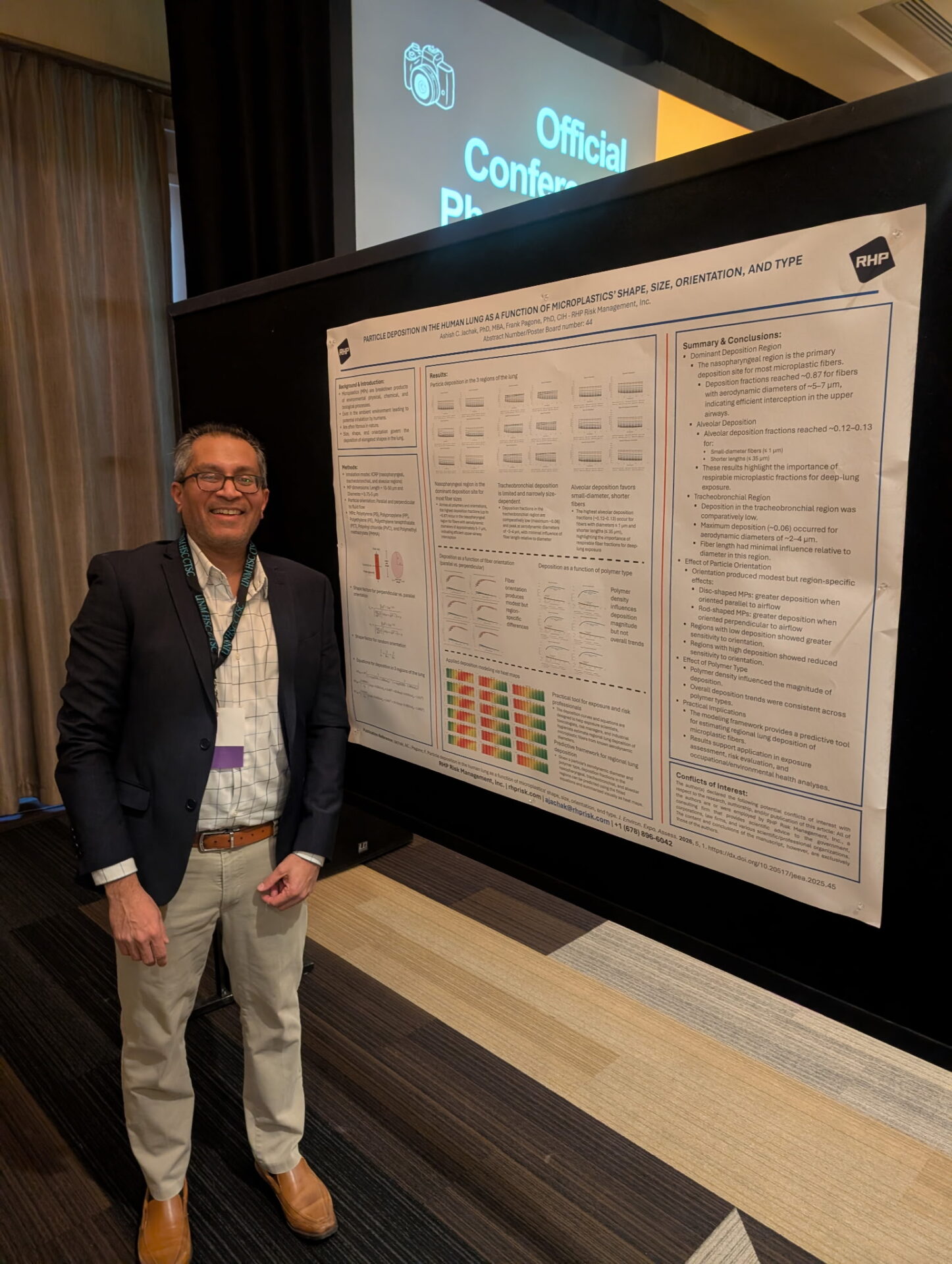
RHP Risk Management’s Ashish Jachak, PhD, MBA presented on RHP scientists’ latest advances in microplastics research at the 2026 Microplastics and Nanoplastics Exposure and Human Health Conference in Santa Fe, New Mexico.
The conference brought together scientists, health professionals, policymakers, and other stakeholders to share cutting-edge research on microplastics and nanoplastics.
Microplastic Shape and Orientation Influence Lung Deposition

Dr. Jachak’s presentation and poster, “Particle Deposition in the Human Lung as a Function of Microplastics’ Shape, Size, Orientation, and Type” and “Associations Between Particle Shape Factor, Orientation, and Deposition for Microplastics in the Human Lung,” examined how particle geometry and orientation influence respiratory deposition patterns. Dr. Jachak’s analyses evaluated elongated, fibrous, and irregularly shaped microplastic particles across a range of sizes and polymer types representative of airborne microplastics reported in environmental studies.
Modeling results suggest that while many microplastic particles are captured in the upper airway, particle shape and orientation in airflow can allow some particles to travel deeper into the lungs. Accounting for the irregular shapes of microplastics rather than assuming they are spherical changed predictions of where particles deposit, which may influence how exposures and potential health risks are evaluated. This work is supported by a peer-reviewed publication in the Journal of Environmental Exposure Assessment (JEEA) authored by Ashish Jachak, PhD, MBA, and Frank Pagone, PhD, CIH.
Screening-Level Risk Characterization of Drinking Water Microplastics
Dr. Jachak’s poster, “Screening-Level Risk Characterization of Microplastics in Drinking Water Across Five U.S. States,” applied a structured screening-level risk assessment framework to measured microplastic concentrations in potable water. The analysis evaluated the potential for microplastics particularly polyethylene (PE) and polyvinyl chloride (PVC) to act as sources for chemical additives such as phthalate plasticizers and antioxidants.
Drinking water samples collected from public libraries in five U.S. states (CA, IL, MI, PA, TN) were analyzed to identify the types of microplastics present. PE and PVC were detected most often. To estimate potential intake, the analysis used a conservative scenario assuming three common plasticizers DIDP, DINP, and DEHP and two antioxidants, Irganox 1010 and 1076.
Estimated exposures were compared with safety benchmarks from the U.S. EPA, EFSA, and ECHA, and all results were below levels of concern under the assumptions used. The analysis shows that screening-level approaches can help evaluate potential risks while also identifying key uncertainties, including particle size, additive content, how chemicals may leach from particles, and long-term exposure.
Advancing Human Health Risk Science at RHP Risk Management
Dr. Jachak’s presentations at the 2026 Microplastics Conference reflect RHP Risk Management’s Human Health Risk Sciences capabilities, which integrate exposure science, toxicology, and risk assessment to address complex and emerging contaminants. Our team supports clients across regulatory, litigation, and product stewardship contexts by developing scientifically defensible evaluations of chemical and particulate exposures across multiple pathways, including inhalation and ingestion.
As microplastics research continues to evolve, RHP applies state-of-the-scientific methods to help organizations interpret data, identify key uncertainties, and make informed, risk-based decisions grounded in human health science.
To learn more about how RHP Risk Management can support your human health risk assessment needs, contact us today at (866) 481-8188.