

Vinyl acetate monomer (VAM) is a synthetic chemical building block used in the production of copolymers such as adhesives, sealants, coatings, and surface treatments. The Office of Environmental Health Hazard Assessment (OEHHA) has identified vinyl acetate as a chemical “known to cause cancer” under Proposition 65.
Effective January 3, 2026, companies selling products containing vinyl acetate in California are required to provide a Proposition 65 warning label, unless a business can show that the product does not expose consumers to significant amounts of VAM under normal foreseeable use conditions.
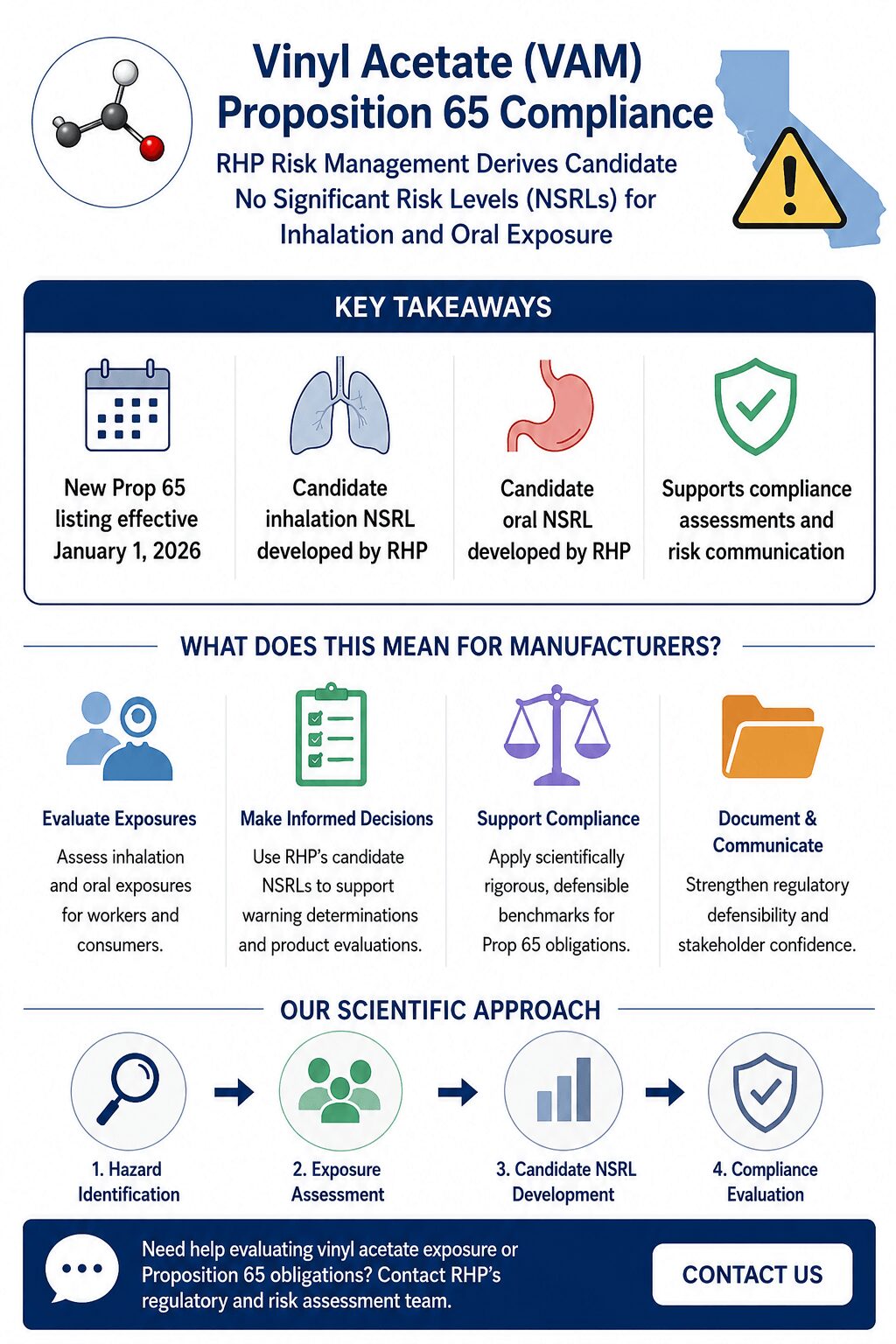
Once added to the Prop 65 list, OEHHA may develop No Significant Risk Level (NSRL) values for cancer-causing chemicals. Under California’s Proposition 65, NRSLs are exposure thresholds providing a “safe harbor” where lifetime cancer risk is below 1-in-100,000 and therefore warnings aren’t needed. With the impending Prop 65 labeling requirements for VAMs, set to take effect in 2026, RHP scientists have taken a unique approach to derive candidate oral and inhalation NSRLs. Health-guidance values such as NSRLs are often derived from a single benchmark dose estimate obtained from one statistical model, treating the point of departure (POD) as a fixed, single-point estimate. This approach does not fully reflect uncertainty associated with model choice or parameter estimation. In this blog, RHP explores probabilistic modeling of benchmark dose analyses to decrease the uncertainty inherent in identifying these health-guidance values.
The carcinogenic potential of VAM has been studied in rat and mouse models for both oral and inhalation exposure routes. RHP identified and reviewed available cancer studies that might be used to derive cancer risk values.
Epidemiology and toxicology studies were identified and considered as potential principal studies. Emphasis was placed on high-quality studies (e.g., detailed method description; dose-response data, etc.) to identify data associated with carcinogenic endpoints that could be used to assess dose-response for the cancer endpoint.
There is uncertainty inherent in setting guidance values, arising from both statistical variability in model parameters and the choice of dose-response model itself; use of probabilistic modeling addresses both sources of uncertainty. We used U.S. Environmental Protection Agency (EPA) benchmark dose modelling software (BMDS) to model the incidence data and Oracle’s Crystal Ball (a spreadsheet-based software application used for predictive modeling, forecasting, simulation, and optimization). This approach uses more detailed information from the data than traditional risk assessment approaches, such as extrapolation from a no effect level, and allows for decreased uncertainty in decision-making.
RHP performed a probabilistic analysis using the distribution of the values underlying the parameter estimates for all viable models considered by BMDS, rather than discrete values calculated by Maximum Likelihood Estimation (MLE) for only the best-fit model in BMDS as determined by lowest AIC for the 9 models considered by BMDS (Hill, Gamma, LogLogistic, Multistage 1, Weibull, Logistic, LogProbit, Probit, Quantal Linear). We then applied model-weighting using AIC weighting constants to generate weighted functions that consider all sources of data variability and avoid model selection bias. Male and female data were modeled separately; however, the resulting modeling yielded similar PODs. Using this set of PODs, RHP then derived candidate oral and inhalation NSRL values for VAM based on target cancer risk estimates of 1 in 100,000, considering typical daily human intake for a 70-year statistical lifetime.
In general, once a chemical has been determined to be a carcinogen, risk assessment defers to the conservative linear dose-response relationship with no observable threshold. This is protective of potential carcinogenic activity. However, there are questions as to whether this should be applicable to all potential carcinogens, particularly where there is a mechanistic rationale for a threshold. Many scientists believe that VAM is one of the substances that has a threshold for cancer (Hengstler et al. 2003; SCHER 2008; Albertini 2013; ATSDR 2025; IARC 1995). Through investigations of mechanisms of toxicity underlying VAM’s potential carcinogenic effects, it appears that VAM’s metabolite acetaldehyde is responsible for its mutagenic activity and that the mutagenicity of acetaldehyde in the body is held in check by the detoxification enzyme aldehyde dehydrogenase (reviewed by Albertini, 2013). Thus, the mechanism by which VAM causes tumors likely has a threshold (i.e., is not linear at lower doses) suggesting a revision to the typical risk assessment approach for carcinogens may be appropriate in this case. If VAM does have a threshold, then evaluation could follow a traditional, non-carcinogen risk assessment approach with a point of departure and uncertainty factors being applied. This would likely result in a higher NSRL value. However, in the current study, RHP applied a conservative approach of assuming a linear no-threshold dose-response as likely to be applied by regulators. This is considered health protective and consistent with OEHHA’s guidance and typical practice.
RHP identified two animal studies, Umeda et al. (2004) and Bogdanffy et al. (1994), as the critical studies for oral and inhalation route data, respectively. VAM is a reactive chemical which tends to have portal-of-entry effects, so the primary health outcomes identified were squamous cell carcinoma of the oral cavity and nasal tumors for oral and inhalation exposure, respectively.
Using a distribution of model-averaged BMD values from these two studies, RHP selected the 5th percentile of the model-averaged BMD distribution for use as a conservative POD, analogous in purpose (but not identical in derivation) to a traditional BMDL. We then used the BMDL values as PODs to calculate a candidate oral NSRL of 749 µg/day and a candidate inhalation NSRL of 167 µg/day.

A recently conducted study measured VAM concentrations in consumer products and modeled estimates of consumer exposure (Gauthier 2025). The authors modeled internal daily doses (mg/kg/day) for multiple exposure pathways (inhalation, dermal, hand-to-mouth, and oral) applicable to 12 scenarios, including: dietary supplement tablet, lip gloss, face mask, arts and craft glue adult use, arts and craft glue child use, joint compound, caulk, seam adhesive, concrete resurfacer, primer, tablet cover, and shelf liner. After adjusting these values to standard body weights (70 kg for adult or 18.6 kg for child), RHP compared the daily dose (µg/day) to our candidate NSRL values. We compared the modeled consumer exposures to the derived candidate NSRLs. For each of the 12 scenarios we found that the estimated daily doses were all below the candidate NSRL values, although values for 6 scenarios approached the candidate NSRLs (arts and craft glue adult use, arts and craft glue child use, joint compound, concrete resurfacer, tablet cover, and shelf liner). These exposure scenarios may benefit from further evaluation such as model validation through exposure simulation studies and collection of empirical data (e.g. measurement of airborne VAM concentrations or dermal exposure assessment), which will strengthen confidence in the risk characterization.
Recently, OEHHA posted a letter providing guidance on testing recommendations for VAM releases from consumer products. RHP maintains a unique capability to conduct exposure simulation testing under different product use scenarios at our Exposure Sciences Laboratory (ESL) . Such data may then be compared to values predicted by exposure models, and models may be data-informed and refined to obtain more realistic estimates of risk and NSRL compliance. By integrating probabilistic risk modeling with empirical exposure simulation, RHP helps clients move beyond conservative screening assumptions toward data-driven compliance strategies.

This work will be presented at the upcoming Society of Toxicology (SOT) Annual Meeting in San Diego, California during the Risk Assessment II session on Tuesday, March 24th from 9:15-11:45am (Abstract #3995; Poster #F457). A manuscript is currently in development.